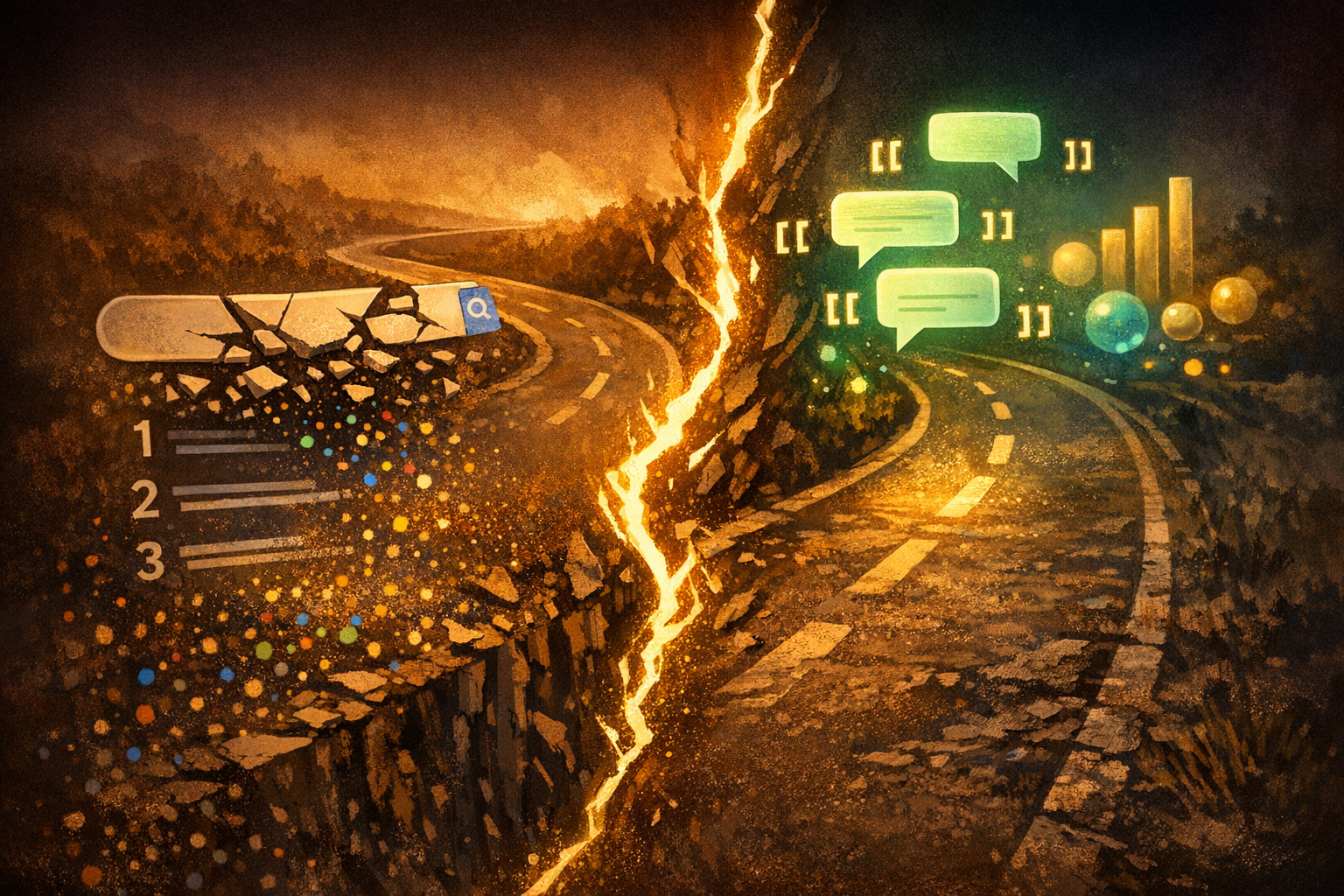
For 25 years, the SEO industry operated on a foundational assumption: rank higher in Google, get more visibility. AI citations just demolished that assumption.
According to Ahrefs’ updated analysis, only 38% of Google AI Overview citations now come from pages ranking in the top 10 organic results. Seven months earlier, that number was 76%. A separate BrightEdge analysis published February 12, 2026 found even lower overlap, at approximately 17%.
Read those numbers again. Between 62% and 83% of AI Overview citations come from pages that are NOT in the top 10 organic results. The ranking position that SEO teams have obsessed over for decades is becoming irrelevant for AI visibility.
This isn’t a minor data point. It’s a paradigm shift that invalidates core assumptions behind how most companies allocate their digital marketing budgets.
The Data in Full Context
Let’s trace the decline in top-10 citation overlap with every data point available:
| Timeframe | Top-10 Citation Overlap | Source |
|---|---|---|
| Mid-2025 | 76% | Ahrefs |
| February 2026 | ~17% | BrightEdge |
| March 2026 | 38% | Ahrefs (updated) |
The discrepancy between Ahrefs (38%) and BrightEdge (17%) reflects different methodologies and datasets, as Search Engine Journal noted. But both point in the same direction: AI Overviews are pulling citations from far beyond the first page of organic results.
Ahrefs also noted that Google upgraded AI Overviews to Gemini 3 globally in January 2026, which may partially explain the accelerating divergence. The newer model appears to have a broader retrieval scope and different authority evaluation criteria than its predecessor.
Industry-Level Variation
The divergence isn’t uniform across industries. ALM Corp’s analysis of AI Overview behavior across nine industries found:
- Entertainment: Top-10 citation overlap grew from 3.2% to 18.5% year-over-year
- Finance: Remains heavily biased toward authoritative, established sources regardless of ranking
- Technology: Shows the widest range, with some queries citing entirely non-ranking sources
- Healthcare: Medical authority signals dominate over ranking position
The variance tells us something important: AI citation algorithms weight different authority signals depending on the industry context. A one-size-fits-all GEO strategy is insufficient.
Why Ranking No Longer Predicts AI Citation
The 76-to-38% drop wasn’t random. Several structural factors explain why AI engines increasingly look beyond the top 10:
1. AI Engines Evaluate Content, Not Rankings
Traditional search ranking is a composite score of hundreds of factors: backlinks, page speed, domain authority, keyword relevance, user engagement signals. AI citation is fundamentally different. When an AI engine needs to cite a source for a specific claim, it evaluates:
- Content specificity: Does this page directly answer the question with concrete data?
- Source authority on the specific topic: Not general domain authority, but topic-specific expertise
- Freshness: Is this the most recent data available?
- Structured clarity: Can the AI easily extract a citable fact or statement?
- Entity consistency: Does this source’s information align with the AI’s knowledge graph?
A page ranking #47 for a broad keyword might have the most specific, recent, and clearly structured answer to the exact question the AI is answering. The AI has no reason to prefer the #1 result if the #47 result is a better citation source.
2. The Gemini 3 Effect
Google’s upgrade to Gemini 3 for AI Overviews in January 2026 brought a fundamentally different retrieval architecture. Where earlier versions relied more heavily on the existing search index ranking, Gemini 3 appears to use a retrieval-augmented generation (RAG) approach with broader corpus access.
This means the AI doesn’t just look at what ranks well for the query. It searches its broader knowledge base for the most relevant and authoritative content, which may come from pages that rank well for entirely different queries.
3. Long-Tail Content Gets Its Moment
The old SEO model rewarded head-term dominance: rank #1 for “best CRM software” and you win. The new AI citation model rewards comprehensive long-tail content. A 3,000-word deep dive on “CRM integration patterns for B2B manufacturing companies with SAP ERP” might never rank in the top 10 for “best CRM software” but could be the perfect citation source when an AI engine answers that specific manufacturing question.
This inversion benefits subject-matter experts over generalist content farms. The specialist who writes deep, narrow content has always struggled to compete on broad keywords. In the AI citation era, that deep content is exactly what gets cited.
The New Authority Model for AI Citations
If ranking position no longer determines citation, what does? Based on the data and observed citation patterns, here’s the emerging authority model:
Topical Authority Over Domain Authority
Traditional SEO measures domain authority as a site-wide metric. AI engines appear to evaluate authority at the topic cluster level. A site with deep, interconnected content on a specific topic will earn more citations for that topic than a high-DA site with shallow coverage.
What to do: Build comprehensive topic clusters around your core expertise. Interlink content within clusters. Demonstrate depth through multiple related articles that cover a topic from every angle.
Entity Recognition Over Keyword Matching
AI engines don’t match keywords; they resolve entities. When a user asks “What’s the best project management tool for remote teams?”, the AI identifies the entities (project management tools, remote teams) and retrieves content from sources it recognizes as authorities on those entities.
What to do: Build your brand’s entity profile. Ensure your brand is consistently described and referenced across the web in contexts related to your expertise. Use schema markup to explicitly declare your entity relationships.
Structural Clarity Over Content Volume
AI engines need to extract specific, citable facts and claims. Content that buries its best insights in paragraph 47 of a wall of text loses to content that presents clear, structured, extractable information.
What to do: Use structured formats relentlessly. FAQ sections with definitive answers. Comparison tables with specific data. Numbered lists of actionable steps. Headers that directly address questions. Pull quotes that contain your strongest claims.
Freshness and Recency Signals
AI engines increasingly weight content freshness, especially for topics where information changes rapidly. The Gemini 3 upgrade appears to have increased the freshness premium in AI Overview citations.
What to do: Update existing content regularly with new data, developments, and analysis. Include last-updated dates prominently. Publish timely content that addresses current developments in your industry.
Source Diversity and Cross-Reference
AI engines appear to favor sources that are themselves cited or referenced by other authoritative sources. This creates a citation network effect: the more other quality sources reference your content, the more likely AI engines are to cite you.
What to do: Create original research, data, and analysis that other publications want to reference. Statistics, studies, benchmarks, and frameworks that become industry reference points are citation magnets.

The Budget Reallocation Question
This data forces an uncomfortable conversation in every marketing department: if ranking in the top 10 only determines 38% (or 17%) of AI citation outcomes, how should budgets be allocated between traditional SEO and GEO?
Current Typical Allocation (Pre-Paradigm Shift)
| Activity | Budget Share | AI Citation Impact |
|---|---|---|
| Link building for ranking | 30-40% | Declining |
| Technical SEO (speed, crawlability) | 15-20% | Moderate (still needed) |
| Content creation for keywords | 25-35% | Declining for broad keywords |
| On-page optimization | 10-15% | Moderate |
| AI visibility monitoring | 0-5% | CRITICAL |
Recommended Allocation (Post-Paradigm Shift)
| Activity | Budget Share | AI Citation Impact |
|---|---|---|
| Topic cluster development | 25-30% | High |
| Entity and authority building | 20-25% | High |
| AI visibility monitoring and optimization | 15-20% | Critical |
| Technical SEO and structured data | 15-20% | High (enables AI extraction) |
| Traditional link building | 10-15% | Moderate (still valuable but less dominant) |
The shift isn’t about abandoning SEO. It’s about recognizing that the activities that drive AI citations are different from the activities that drive traditional rankings. And with AI Overviews appearing in 25% of searches (and growing 91% year-over-year), the AI citation budget needs to reflect the AI citation reality.
What SE Ranking’s Study Adds
SE Ranking’s analysis of 2.3 million pages provides additional nuance on what drives AI citations:
- Domain traffic is the #1 predictor of AI citations, with high-traffic sites earning 3x more citations than low-traffic ones
- Content depth and structure are the second most important factor
- Freshness matters significantly, especially for news and technology queries
The domain traffic finding seems to contradict the “ranking doesn’t matter” thesis, but it actually reinforces it. Domain traffic is a proxy for overall brand authority, not ranking for any specific keyword. A well-known brand with high traffic can earn AI citations for content that ranks on page 5 or lower, precisely because the domain itself is recognized as authoritative.
The ChatGPT Citation Behavior Comparison
Google AI Overviews aren’t the only citation game in town. ChatGPT accounts for 87.4% of all AI referral traffic (Conductor 2026), and its citation behavior differs from Google’s:
- ChatGPT is more likely to cite content with definite language (not vague claims)
- Content with high entity density receives more citations (Growth Memo, February 2026)
- Question marks in content correlate with higher citation rates
- A balanced mix of facts and opinions outperforms purely factual or purely opinion content
- Simple writing structures are preferred over complex prose
These behavioral differences between AI engines mean that optimizing for Google AI Overview citations may not optimize for ChatGPT citations and vice versa. Multi-engine optimization is not just a nice-to-have; it’s a strategic necessity.
The Practical Takeaway: A 30-Day AI Citation Audit
Here’s a concrete framework for evaluating and improving your AI citation position:
Week 1: Baseline Measurement
- Query 5 AI engines (ChatGPT, Perplexity, Google AI Mode, Claude, Gemini) with 20 queries relevant to your business
- Document which queries cite your brand, which cite competitors, and which cite neither
- Calculate your baseline AI visibility score across engines
Week 2: Content Gap Analysis
- For queries where competitors are cited and you’re not, analyze what their cited content does differently
- Map content gaps: topics where you have expertise but no structured, citable content
- Identify your existing content that ranks well organically but isn’t getting AI citations
Week 3: Structured Content Creation
- Create or restructure 5-10 pieces of content specifically optimized for AI citation
- Focus on: answer-first structure, FAQ sections, data tables, clear entity references, definitive claims with sources
- Use schema markup (FAQ, Article, HowTo) on all restructured content
Week 4: Monitor and Iterate
- Re-run the Week 1 queries and measure changes
- Track new citations and identify which content changes drove them
- Build a recurring monitoring cadence for AI citations across engines
Frequently Asked Questions
Why did AI Overview citations from top-10 pages drop from 76% to 38%?
The primary driver appears to be Google’s upgrade to Gemini 3 for AI Overviews in January 2026. The newer AI model uses a broader retrieval scope that evaluates content authority at the topic level rather than relying heavily on the existing search ranking index. This means the AI actively seeks out the most relevant and authoritative content regardless of where it ranks in traditional search results.
Does this mean SEO rankings are worthless?
No. Ranking in the top 10 still accounts for 38% of AI Overview citations (Ahrefs data), and traditional organic traffic from ranking remains valuable. What’s changed is that ranking alone is no longer sufficient for AI visibility. Brands need to optimize for both traditional ranking factors AND AI citation factors, which increasingly diverge.
What content formats get cited most by AI engines?
Based on aggregated research from SE Ranking, Growth Memo, and Conductor: FAQ sections with definitive answers, comparison tables with specific data, content with high entity density, pages with clear and simple writing structures, and content that uses definite rather than vague language. AI engines prefer structured, extractable information over narrative-heavy prose.
How different are AI citation factors across engines (Google vs. ChatGPT vs. Perplexity)?
Significantly different. Google AI Overviews weight freshness and domain traffic heavily. ChatGPT favors entity density, definite language, and balanced fact-opinion content. Perplexity prioritizes source freshness and citation-chain authority. Claude appears to weight topical depth and content comprehensiveness. A multi-engine GEO strategy needs to account for these platform-specific behaviors.
Should I stop building backlinks if ranking doesn’t determine AI citations?
Don’t stop, but reframe the purpose. Backlinks still contribute to domain authority and brand recognition, both of which influence AI citations indirectly. However, the ROI of purely rank-focused link building is declining. Invest more in earning references from topic-relevant authoritative sources that build your entity authority across the web, which benefits both traditional SEO and AI citation simultaneously.
Check your brand’s AI visibility score at iscore.ai